
Criminal Cases in the Pettis County Courts
Pettis County belongs to Missouri's 18th Judicial Circuit. Felony prosecutions and state-law misdemeanors are filed in Circuit Court. Associate divisions handle assigned lower-level state matters, while municipal divisions decide alleged city-ordinance violations. That division matters because a searcher must choose the docket that owns the case, not simply the law-enforcement agency that made an arrest.
The Pettis County Circuit Clerk keeps civil, criminal, probate, domestic, and juvenile court files. Criminal, traffic, probate, and juvenile counters are on the courthouse first floor. The clerk's file is the official local source for pleadings, orders, judgments, and copies. Case.net provides public information from that system, but it does not turn every filed document into a home download.
Pettis Criminal Court Divisions
Local rules identify Pettis Division IV as Circuit, Division V as Probate, and Division VI as Associate Circuit. Municipal dockets are numbered separately: La Monte is Division VIII, Smithton is Division XI, and Sedalia is Division XII. Green Ridge, Hughesville, and Houstonia do not currently maintain municipal courts under those rules. Their matters transfer to Pettis Division IV.
This local setup prevents a common error. A person looking for a Green Ridge ordinance record should not wait for a standalone municipal clerk that does not exist. The Sedalia Municipal Court page confirms that ordinance cases run through Pettis County Circuit Court at the courthouse, even though the conduct arose under city law. Search the court and division shown on the case header, then ask the Circuit Clerk when the division is unclear.
Note: A police jurisdiction and a court division answer different questions, so confirm both before requesting a Pettis County case file.
How to Search Case Records
Missouri Case.net is the main remote path for a Pettis County criminal case search. A known case number is the strongest key. With only a name, add the first and middle names, year of birth when offered, criminal or traffic case type, and Pettis County or the 18th Judicial Circuit. A scheduled-hearing search answers where and when court will sit, not how a charge ended.
- Open Case.net and select Litigant Name Search, or choose Case Number Search when the identifier is known.
- Enter the surname and add the available name details. Narrow the court to Pettis County or the 18th Judicial Circuit.
- Open the case-number link. Confirm the court, filing date, parties, and case type before reading further.
- Review each charge, docket event, hearing, judgment, and financial entry. Read the outcome count by count.
- Use the courthouse public terminal or contact the Circuit Clerk for a public item that is not remotely viewable and ask about plain or certified copies.
| Field Label | Type | Required | Notes |
|---|---|---|---|
| Last Name / Business Name | Text | Yes in name mode | Use the legal surname |
| First and Middle Name | Text | Optional | Helps separate common names |
| Case Type | Dropdown | Optional | Choose criminal or traffic when offered |
| Filing Date Range | Date fields | Optional | Limits older results |
| Court / County | Dropdown | Recommended | Select Pettis or the 18th Circuit |
| Case Number | Text | Yes in number mode | Use the exact court identifier |
Save the case number before leaving the result. It is the best reference for a later clerk request, a return visit to the docket, or a comparison with an arrest record. Names can change or collide, but the court identifier stays tied to that Pettis County filing.
Pettis Criminal Case Search Limits
Case.net has four useful routes: litigant name, filing date, case number, and scheduled hearings and trials. Each serves a different task. A broad name search can time out or mix people with similar names. Narrowing by Pettis County, filing year, case type, and birth year helps. When the exact number appears on a notice or prior filing, the case-number mode avoids most name collisions.
An “ECASE” label means the court maintains an electronic record. It does not promise that every attachment is open online. A linked docket entry indicates an attachment the current user may view. No link can mean that no attachment exists or that remote access is restricted. Public access is informational and can change as clerks add entries, judges rule, or redaction status changes.
What the Case File Shows
A Pettis County criminal case file begins with the filed accusation and builds a court history. The header identifies the court, number, filing date, status, judge, and division. Party entries identify the State, defendant, prosecutor, defense lawyer, and their roles. Charges may change, so the first wording on the docket is not always the final count resolved by the court.
| Case Number & Court | The unique court identifier, Pettis division, case type, filing date, and status. |
|---|---|
| Charging Document | The complaint, information, or indictment stating the formal allegations. |
| Docket Entries | Dated filings, motions, orders, clerk notes, and public attachments where permitted. |
| Hearing Dates | The date, time, type, location or division, and assigned judge. |
| Disposition & Judgment | The plea or trial outcome for each count, including dismissal or acquittal. |
| Sentence & Conditions | Confinement, probation, fines, costs, restitution, and other terms when posted. |
Full Social Security numbers, protected victim or child identities, confidential examinations, and sealed or expunged material do not belong in the public view. The case file also differs from a police report. It records prosecution and adjudication, not the arresting officer's full investigation.
Read Pettis Criminal Charges Carefully
One Pettis County case may contain several counts with different results. A prosecutor may amend an original allegation, dismiss another count, and obtain a plea on a third. Read the description, Missouri charge code, class, amendment history, plea, outcome, outcome date, and sentence on each line. The existence of a filed case is not itself a conviction.
- Disposition
- The result of one charge, such as conviction, dismissal, or acquittal.
- Nolle prosequi
- A prosecutor's formal choice not to continue a charge at that time.
- SIS
- A suspended imposition of sentence during probation, with distinct later public-record treatment after successful completion.
- SES
- A suspended execution of sentence, meaning the court imposed a sentence but stayed its execution during probation.
The Pettis County Prosecuting Attorney files state charges and provides victim services, but the Circuit Clerk remains the court-file custodian. The official prosecutor page is also the source of one assigned page image.
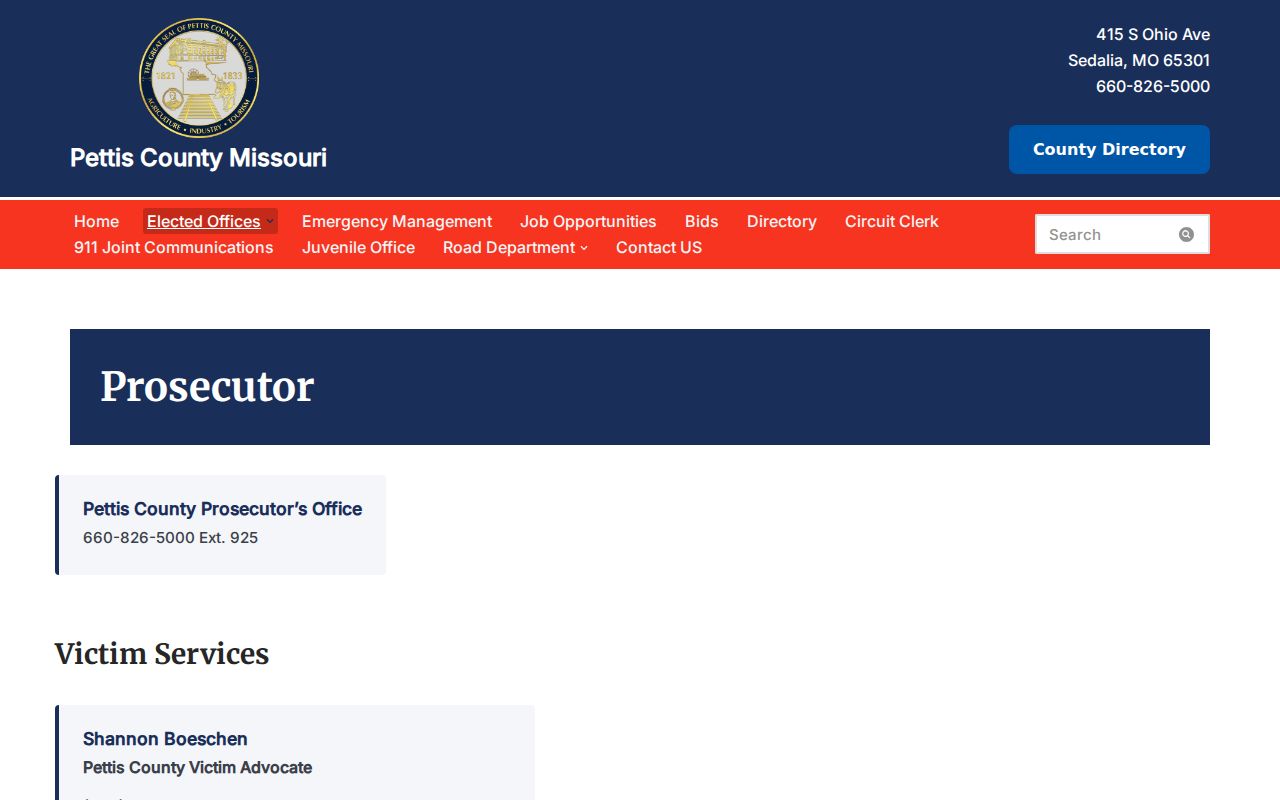
The image places the prosecutor's role beside the court record without confusing the two offices.
Stages of a Criminal Case
An arrest may come first, followed by an initial appearance. A prosecutor then files a complaint or information, or a grand jury returns an indictment. Arraignment tells the accused the charges and records a plea. Pretrial motions and hearings shape what evidence and issues remain. Resolution may be a negotiated plea, trial, dismissal, or nolle prosequi. Judgment and sentence follow a finding of guilt, and an appeal may create a separate appellate trail.
Case flow: Charges Filed › Arraignment › Pretrial › Plea or Trial › Disposition › Sentencing
Timing varies with the case. Do not infer a deadline or outcome from a gap between docket entries. A newly filed charge can lack later hearings, while an older case can gain entries after review, collection activity, or an appeal. The current docket and clerk file provide the best sequence.
Pettis Criminal Case Office
The Circuit Clerk's criminal and traffic counter is at 415 S. Ohio Ave., Sedalia, Missouri. Public hours are Monday through Friday, 8 a.m. to 5 p.m. Call 660-826-5000 extension 924 for criminal or traffic records, or use fax 660-827-8613. Confirm current copy and certification prices before ordering because no official Pettis fee schedule was located in the research.
Ask for the case by exact number when possible and state whether a plain copy or certified copy is needed. A certified copy bears the clerk's authentication. If Case.net shows a docket line but not the document, identify that date and description. For a person reviewing a case in which defense counsel is needed, the Missouri State Public Defender explains its role and service channels.
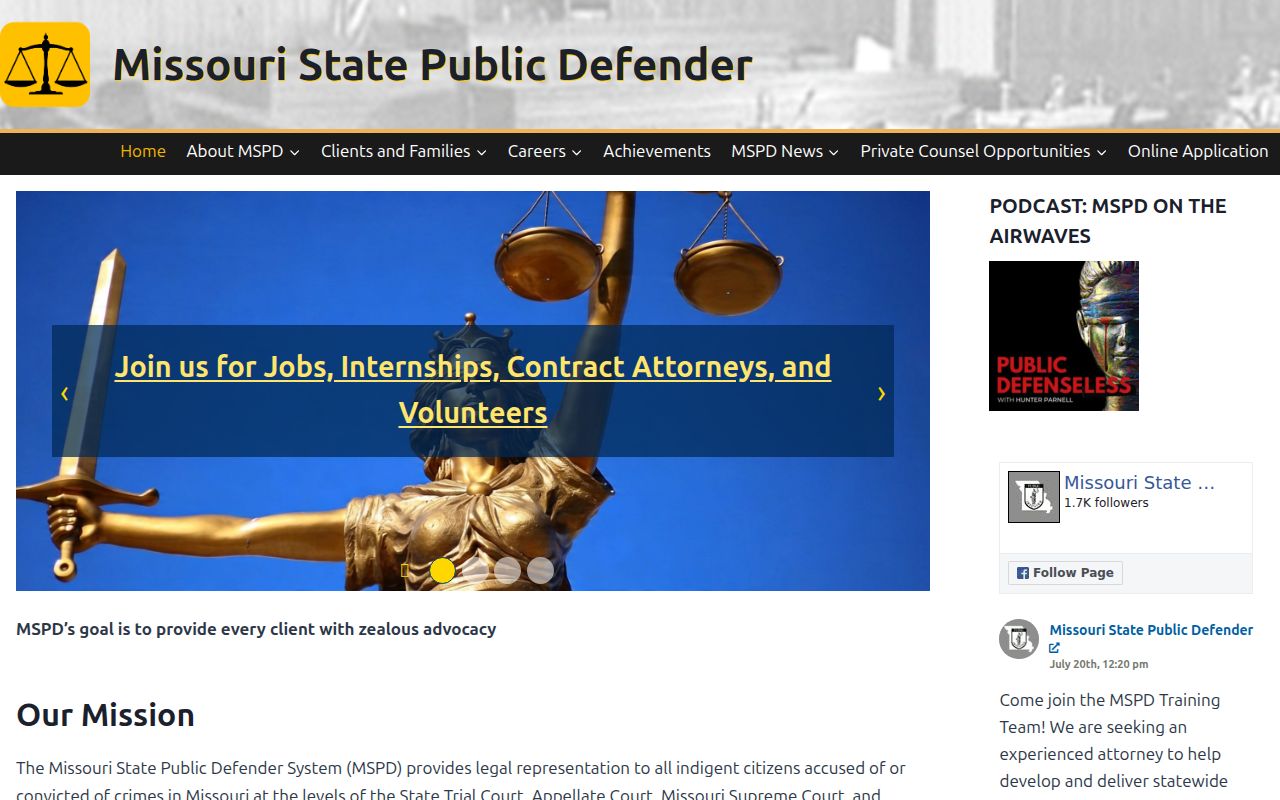
The official public defender screen is a service gateway, not a substitute for the Pettis County docket or clerk file.
Access & Restrictions
Missouri Court Operating Rule 2 and the court's File Viewer rules govern public judicial access. Open court information can be searched, but statutes, court orders, security levels, sealing, and redaction still control each item. Juvenile matters, victim and child identifiers, full dates of birth, Social Security numbers, protected addresses, medical material, and sealed or expunged records may be restricted.
Missouri File Viewer guidance explains why remote document access varies even within an electronic case.
A missing name does not prove no case exists. Check spelling, aliases, date range, case type, county, and exact case number. Then ask the clerk whether a public record is available at the terminal or by request. Closed material does not become public merely because the requester visits in person. For broader distinctions among court, arrest, and repository files, see the Pettis County criminal history overview.
Note: Case.net is a public information tool, while the Pettis County Circuit Clerk remains the source for an official certified court record.
Federal Cases From Pettis County
Federal prosecutions arising in Pettis County do not appear as state cases in Case.net. Pettis County lies in the Western District of Missouri, and federal dockets run through PACER. A state search that finds no case therefore cannot answer whether a federal matter exists. Use the correct court system based on the charging authority.
The federal layer should stay separate from the county file. A related local arrest report may remain with a county or city agency, while the prosecution docket belongs to the federal court. Match names and event dates with care, then rely on the docket number and filed documents for the federal outcome.